
Holding Space When There’s Resistance: What to Do When a Circle Gets Hard

Abstract
Even the best-designed Healing Circles will eventually meet resistance—eye rolls, shutdowns, power plays, silence, sarcasm, or emotional escalation. This article equips facilitators with reflective tools and relational strategies for navigating resistance not as a failure, but as part of the healing process. Drawing from trauma-informed facilitation, implied neuroscience, including polyvagal theory, and the Four-Layer Model, we offer field-tested practices for holding space with groundedness, curiosity, and non-reactivity.
Keywords
Resistance, Circle facilitation, SWEET Healing Circle, SWEET Institute, trauma-informed response, psychological safety, emotional regulation, Four-Layer Model, co-regulation, group dynamics, rupture and repair
1. Introduction
Every Healing Circle begins with openness; but at some point, it will meet resistance. The room gets quiet, or the jokes get louder; someone says, “This feels weird,” or someone storms out. This isn’t the end, it’s the middle, and it’s where the real work begins. This article teaches you how to meet resistance with regulation, reflection, and rhythm.
2. Theoretical Framework: Resistance as Self-Protection, Not Defiance
2.1 Resistance as Emotional Safety Strategy
According to trauma-informed theory, resistance is a sign of protection, not defiance (Bloom, 2013). People resist when:
They don’t feel safe
They don’t understand the purpose
They’re being asked to feel something they’ve avoided
They’ve experienced facilitation that lacked respect or rhythm
2.2 Polyvagal Awareness in Group Resistance
When groups sense tension, the nervous system often moves into fight (sarcasm, dominance), flight (withdrawal, shutdown), or freeze (silence, checking out) (Porges, 2011). The facilitator’s job is to regulate their own nervous system first and then invite the group into safety—not through force, but through rhythm.
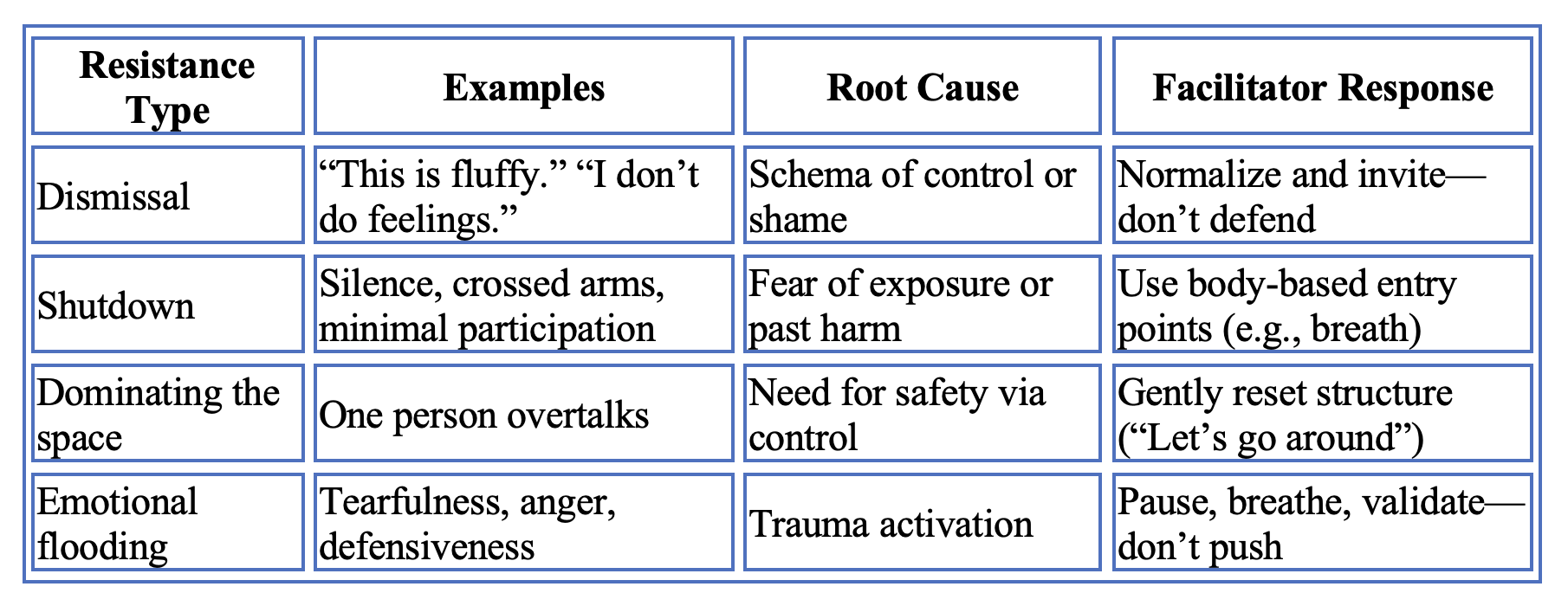
3. Application: What Resistance Looks Like, and What to Do
3.1 Types of Resistance
4. Facilitator Tools for Grounded Response
When the Circle Tenses:
Breathe—Slow, grounded breath regulates the room
Anchor—Touch your feet to the floor or place hand on heart
Reset—Say, “Let’s pause for a moment and breathe together”
When Someone Challenges the Circle:
“I appreciate you naming that. It’s okay not to love this. Please tell me what part feels hard or unfamiliar.”
“This Circle is an invitation, not a mandate. Tell me what’s coming up for you right now.”
“You don’t have to agree with the Circle—just be in it.”
When You Feel Uncertain:
Return to the structure: Breath, inquiry, listening
Ask yourself: “What is this resistance protecting?”
Repeat: “I don’t have to fix this. I just have to hold it.”
5. Repairing After Rupture
If a Circle goes poorly:
Name it (without blame) in the next session
Reflect on what got missed or bypassed
Invite input: “What would help this feel safer or more grounded?”
Rupture is not a failure. Unrepaired rupture is.
6. Conclusion
Resistance doesn’t mean the Circle isn’t working. It means something deeper is being touched. As a facilitator, your power lies not in preventing discomfort—but in holding space for truth with breath, rhythm, and care. That’s what makes the Circle precious; and that’s what turns resistance into reflection.
References
Bloom, Sandra L. Creating Sanctuary: Toward the Evolution of Sane Societies. Routledge, 2013.
Brown, Brené. Dare to Lead. Random House, 2018.
Porges, Stephen W. The Polyvagal Theory. W. W. Norton, 2011.
Siegel, Daniel J. Mindsight: The New Science of Personal Transformation. Bantam, 2010.
van der Kolk, Bessel A. The Body Keeps the Score. Viking, 2014.